
A new report from the McKinsey Institute for Economic Mobility and Heartland Forward — America's Next Growth Opportunity: An Investment-Ready Heartland (October 2026) — makes a case that will feel strikingly familiar to anyone who allocates capital across emerging and frontier markets. The argument is simple: the center of the United States is one of the country's largest underrecognized economic opportunities, and the gap holding it back is not a lack of fundamentals but a lack of what the report calls "investment readiness."
At Veridian Partners, our work sits at the intersection of cross-border capital and real assets — much of it in markets that are economically sound but structurally overlooked. As I was reading this report, the parallels between how global investors evaluate an overlooked emerging market and how they might evaluate the American heartland are hard to miss. This piece takes McKinsey's framework and reads it through that lens: not as a summary, but as a set of takeaways for how investors might think about the opportunity.

The Core Disconnect
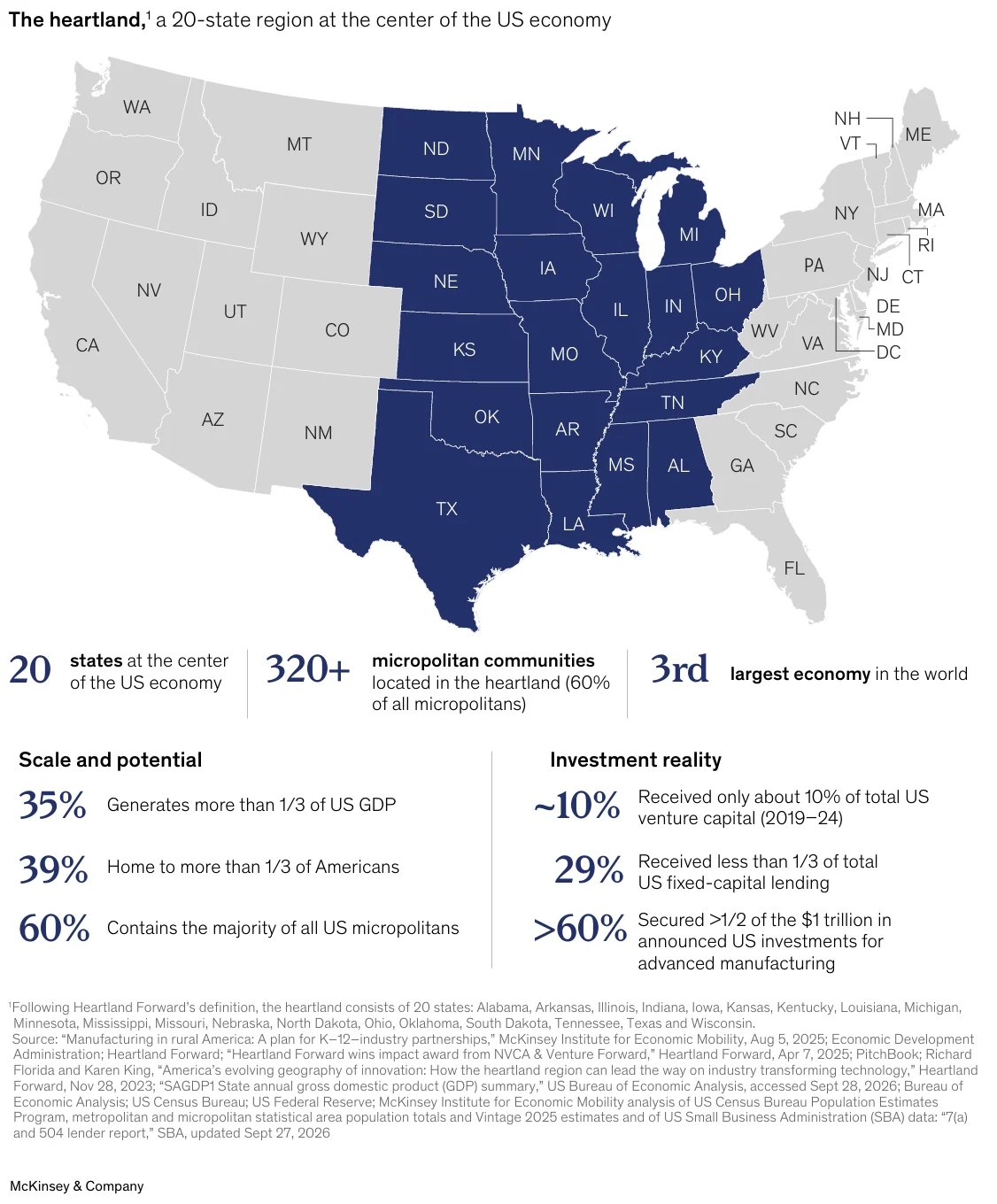
The headline numbers are worth stating plainly, because they define the opportunity. The "heartland", a 20-state region at the center of the country, generates more than a third of US GDP and is home to roughly 39% of Americans. On its own, it would rank as the third-largest economy in the world. Yet it attracts only about 10% of US venture capital and 29% of fixed-capital lending, and rural areas within it draw just 7% of philanthropic funding.
Courtesy McKinsey & Heartland Forward
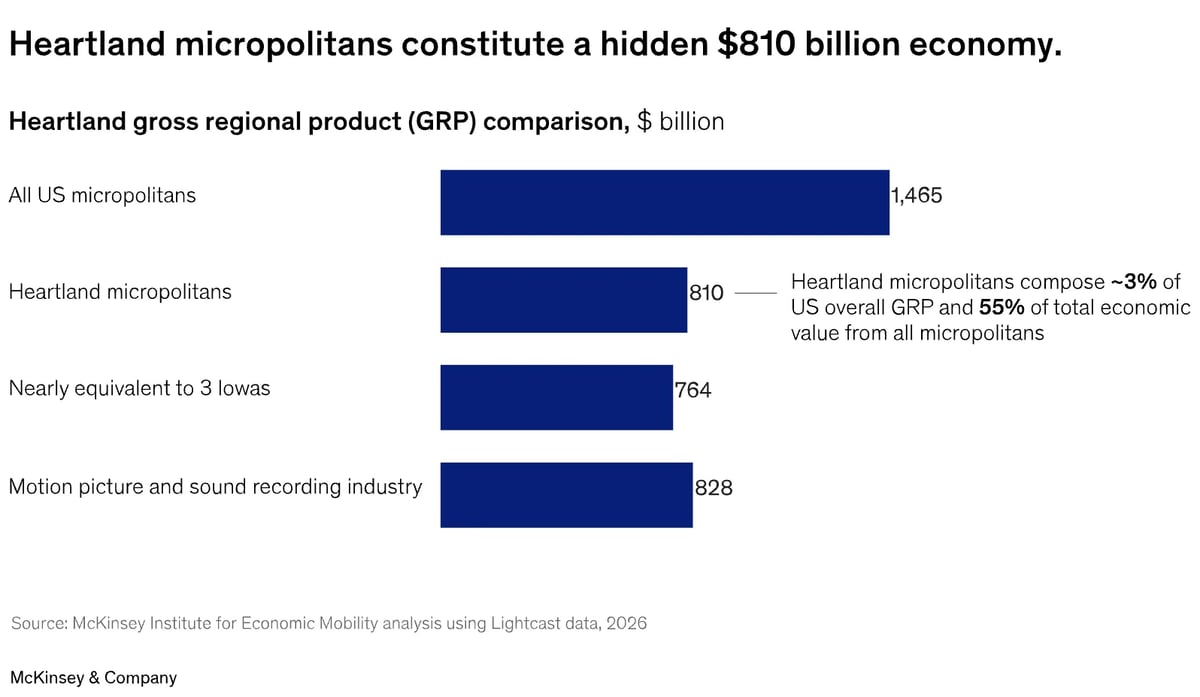
That is a disconnect between economic weight and capital inflow. For anyone who has looked at a country whose GDP and demographics far outrun the investment it receives, this is a recognizable pattern. McKinsey quantifies the prize: if the heartland's share of US GDP matched its share of population, the region would generate roughly $2 trillion in additional output. The report also isolates a quieter figure that would interest real-asset investors specifically — heartland micropolitan areas (smaller cities with urban cores of 10,000 to 50,000 people) alone constitute an $810 billion economy, equivalent to about 55% of the economic value produced by all US micropolitans. When I was in my undergraduate studies, I lived in a micropolitan area (Eau Claire, WI) and these are often overlooked markets for real asset investment.
Courtesy McKinsey & Heartland Forward
Takeaway one: the heartland is an underweighted allocation and the capital gap exists alongside strong fundamentals. That is precisely the profile that rewards early and intentional development strategies.
Assets Are Not the Differentiator, Readiness Is

The most useful idea in the report, and the one most transferable to cross-border investing, is this: communities with nearly identical assets — similar industries, workforce, geography — routinely produce very different investment outcomes. The difference, according to McKinsey, lies not in the assets a place holds but in its ability to organize those assets into investable opportunities.
This is a familiar truth in emerging markets. Two countries can have comparable mineral reserves, comparable labor costs, and comparable location advantages, and yet one attracts long-term investment while the other does not. What separates them is rarely the resource. It is the legal clarity, the institutional coordination, the predictability of process (will property rights be respected 20 years from now when it's time for us to exit?), and the track record of execution — the conditions that let an investor underwrite a project with confidence.
McKinsey builds this into a three-part framework for assessing a community's investment readiness:
Economic context: whether a place has a credible proposition for where it can compete and grow, including its industry base and the enablers (workforce, infrastructure, sites) that support it.
Community assets and systems: whether housing, schools, childcare, healthcare, and quality of life can sustain and attract a workforce. These are the conditions that make growth durable rather than temporary. The key variable in this column is affordability metrics.
Economic development coordination: whether local institutions can align priorities, present a consistent case to investors, and execute a strategy over time.
Takeaway two: diligence on a heartland market should look a lot like diligence on a frontier one. An investor evaluating a smaller US city would do well to assess coordination capacity and execution track record with the same rigor they would apply to a cross-border project — because, as in emerging markets, those soft factors often determine whether capital gets deployed productively or gets stuck.
Not Every Market Is at the Same Stage
The report resists a one-size-fits-all story, and this nuance matters for allocation. McKinsey places communities along a spectrum of three readiness profiles:
Organic or opportunistic — places with real assets and some momentum, where the near-term opportunity is reactive and project-specific.
Targeted engagement — places with a genuine right to win in a few sectors, where closer coordination and focused enabling conditions can accelerate growth.
Economy-shifting — places with the institutional capacity to absorb transformational, large-scale investment.
This is essentially a risk-and-readiness curve, and it maps cleanly onto how disciplined investors already think about market entry. The same capital allocator does not approach a nascent frontier market and a maturing one with the same instrument or the same time horizon. The heartland, McKinsey shows, contains the full spectrum — which means the question is not "is the heartland ready?" but "which parts, for which kind of capital, at which stage?"

Takeaway three: match the instrument to the readiness stage. Opportunistic markets reward project-specific capital; economy-shifting ones can support transformational commitments. Misreading the stage is how capital gets mispriced in overlooked markets everywhere.
Where the Real Assets Are Moving
For investors focused on real assets — our primary area at Veridian Partners — the report surfaces a signal worth underlining. Roughly 63% of the $1 trillion in announced advanced-manufacturing investment in the US is destined for facilities within 15 miles of rural communities. The reshoring and supply-chain-resilience wave that has dominated industrial strategy for several years in the US is, in large part, a heartland story.
That has direct implications for the asset classes that follow major employers: workforce housing (multifamily + affordable), logistics and industrial real estate, healthcare capacity, and the infrastructure that supports all three.

McKinsey's case studies make the point concretely: a specialized pharmaceutical facility anchoring in McPherson, Kansas; coordinated downtown reinvestment compounding private capital in Ottumwa, Iowa.
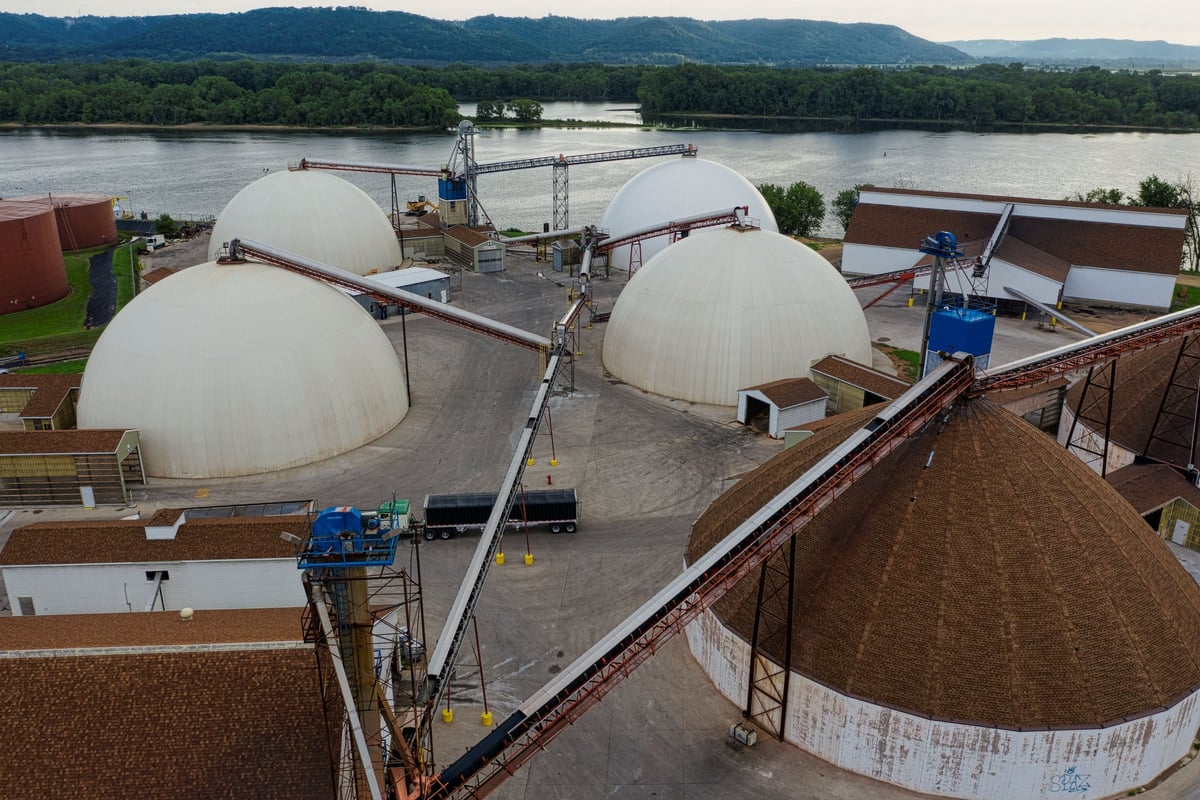
These are not speculative bets on sentiment. They are places where an industrial anchor or a coordinated local strategy created a platform that patient capital could build on.
Takeaway four: follow the industrial anchors. Where advanced manufacturing lands, demand for real assets follows, and the communities that have done the coordination work are positioned to capture it rather than watch it pass through.
The Role Capital Itself Can Play
One of the report's more interesting arguments is that investors are not merely spectators waiting for communities to become ready — they can be participants in creating readiness. McKinsey frames the private-sector opportunity in two parts: acting as investors who treat smaller markets as an untapped asset class rather than an afterthought, and acting through employers who help build the housing, childcare, and training pipelines that make a workforce stable.
This, too, echoes emerging-market practice, where the most effective investment often does more than buy an asset — it helps build the conditions around the asset that protect and compound its value. Financial institutions designing lending products tailored to smaller communities, rather than applying rigid urban underwriting models, is the domestic version of a lender adapting its standards to the realities of a frontier market instead of penalizing it for not looking like London or New York.
Reading It Through Veridian's Lens
What makes this report resonate for us is that its central discipline — evaluate readiness, not just assets; match the capital to the proper stage; treat overlooked markets as requiring a revision rather than unworthy — is the same discipline that governs sound cross-border investing anywhere. The American heartland and an emerging market in Africa or the Gulf are, of course, very different places at the moment. But the analytical posture an investor brings them does not need to be so far off. In both, the edge comes from looking carefully at the conditions that turn fundamentals into deployable opportunities, and from arriving with informed conviction before the broader market catches up.
We work at that intersection, helping capital find, evaluate, and structure opportunities in markets that are fundamentally sound but under-covered. It doesn't matter whether those markets sit abroad or in the middle of the United States. The heartland, on the evidence McKinsey and Heartland Forward have assembled, belongs firmly in that conversation.
This article discusses findings from "America's Next Growth Opportunity: An Investment-Ready Heartland," published by the McKinsey Institute for Economic Mobility in collaboration with Heartland Forward (October 2026). All data and the investment-readiness framework are attributable to that report. This commentary is for general informational purposes only and does not constitute investment advice. All credit on research goes to the McKinsey Institute for Economic Mobility & Heartland Forward.
Get In Touch
Contact Us
Article Written By
Martin Kocher
Managing Partner, Veridian Global Partners